Today was the regular Thursday 8-ball tournament at the senior center. I drew number 13 as my number for match-up purposes, and while others thought that was a most unlucky number, I explained how happy I was to have it because the letter M is the 13th letter of the alphabet, and my initials are MM, so that's double lucky.
Strangely, things started out poorly with a loss in the first match, but it was all good news after that and I sailed to the finals against Eric the Brit, whose reputation preceded him as having held the crown at this tournament for 10 weeks straight. No question he was the man to beat. I guess I got lucky because he scratched on the 8 in the first game, and I won the second for the 2-out-of-3 match.
The tournament took place within 12 hours of the New Moon, which is always a good time for me, so I guess I had everything going my way.
I'm on my way home, just pulling in the driveway, when Dr. Mark waves from his pickup truck and follows me down the driveway. It seems he's got a few spare minutes and wants to try his luck at some 8 ball. His timing was inauspicious, of course. He breaks dry, and I run out. He wants to go again, for the World Championship, but it was my day, and he left after going down in flames in two games.
I'm writing this within 90 minutes of both wins, so I'm all jacked up on New Moon Lucky Alpha Geezer moxie juice, and thinking maybe I should try another tournament tonight and see if I can pull a three-peat hat-trick.
Hey, it could happen!
Gold Crown IV
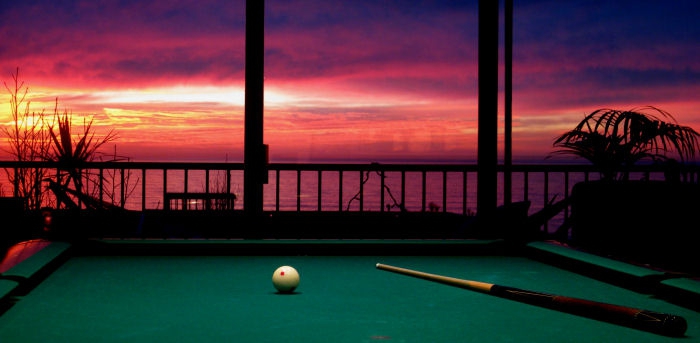
FastMikie's Fun House, Del Mar, California
Thursday, July 31, 2008

Monday, July 28, 2008
Quiet Eye - why the pause in the backswing works
Alison Fisher's very pronounced pause at the end of the back swing, prior to releasing her stroke, could be a primary reason for her excellence at pocket billiards. For some research on this topic, check out this study (PDF file) published in the Journal of Motor Behavior, 2002. The basic premise is that the more successful billiard players have a longer period of "Quiet Eye" and that this time is used to more effectively program the factors in delivering an accurate stroke. Here's the abstract of the study:
ABSTRACT. Skilled (n = 12) and less skilled (n = 12) billiards
players participated in 2 experiments in which the relationship
between quiet eye duration, expertise, and task complexity was
examined in a near and a far aiming task. Quiet eye was defined as
the final fixation on the target prior to the initiation of movement.
In Experiment 1, skilled performers exhibited longer fixations on
the target (quiet eye) during the preparation phase of the action
than their less skilled counterparts did. Quiet eye duration
increased as a function of shot difficulty and was proportionally
longer on successful than on unsuccessful shots for both groups of
participants. In Experiment 2, participants executed shots under 3
different time-constrained conditions in which quiet eye periods
were experimentally manipulated. Shorter quiet eye periods resulted
in poorer performance, irrespective of participant skill level.
The authors argue that quiet eye duration represents a critical period
for movement programming in the aiming response.
ABSTRACT. Skilled (n = 12) and less skilled (n = 12) billiards
players participated in 2 experiments in which the relationship
between quiet eye duration, expertise, and task complexity was
examined in a near and a far aiming task. Quiet eye was defined as
the final fixation on the target prior to the initiation of movement.
In Experiment 1, skilled performers exhibited longer fixations on
the target (quiet eye) during the preparation phase of the action
than their less skilled counterparts did. Quiet eye duration
increased as a function of shot difficulty and was proportionally
longer on successful than on unsuccessful shots for both groups of
participants. In Experiment 2, participants executed shots under 3
different time-constrained conditions in which quiet eye periods
were experimentally manipulated. Shorter quiet eye periods resulted
in poorer performance, irrespective of participant skill level.
The authors argue that quiet eye duration represents a critical period
for movement programming in the aiming response.
Sports are 80 percent mental
And just to prove that "Sports are 80 percent mental" check out the blog by the same name: http://blog.80percentmental.com/
(some people say its 90%, but the difference isn't worth arguing about)
There are no billiards related posts there, yet, but I'm thinking that the mental part of most sports should be relatively similar.
I knew I was going to like this blog when I read agreement with my previous posts that it take 10 years of practice for a novice to become an expert.
I always like it when people agree with me!
;o)
(some people say its 90%, but the difference isn't worth arguing about)
There are no billiards related posts there, yet, but I'm thinking that the mental part of most sports should be relatively similar.
I knew I was going to like this blog when I read agreement with my previous posts that it take 10 years of practice for a novice to become an expert.
I always like it when people agree with me!
;o)
Saturday, July 26, 2008
Experiments
When Earl Strickland and Johnny Archer were here giving me some lessons last week, one of the suggestions they had for me was to take some weight off my cues. At 20.5 ounces each, they figured they were just too heavy. Since my right shoulder has been giving me continuing problems with pain and stiffness, I'm thinking taking some of the weight off might even help relieve those conditions.
So it was off to Quality Billiards in Santee, CA to get Dave Whitsell to remove some weight from both my break and playing cues. Now the break cue is 18.7 oz. and the playing cue is 19.2 oz. and since they now have no weight bolts at all in the butt, that's as light as they're going to get.
They feel better, but the proof will be in the playing.
While I was at the shop today, I also got one of my spare shafts fitted with an Elk Master tip, which Earl Strickland highly recommended. And not just any Elk Master tip, but only the 20 year old tips which are much different than the current kind. As luck would have it, Dave W. had a few, so now I should be able to stroke like Earl. Right...
Experiments! You might think that after 5 years of serious play I would have figured out what works best, but there are so many choices, I may never settle down to one combination of shaft/tip/weight/cue/etc.
(top)
So it was off to Quality Billiards in Santee, CA to get Dave Whitsell to remove some weight from both my break and playing cues. Now the break cue is 18.7 oz. and the playing cue is 19.2 oz. and since they now have no weight bolts at all in the butt, that's as light as they're going to get.
They feel better, but the proof will be in the playing.
While I was at the shop today, I also got one of my spare shafts fitted with an Elk Master tip, which Earl Strickland highly recommended. And not just any Elk Master tip, but only the 20 year old tips which are much different than the current kind. As luck would have it, Dave W. had a few, so now I should be able to stroke like Earl. Right...
Experiments! You might think that after 5 years of serious play I would have figured out what works best, but there are so many choices, I may never settle down to one combination of shaft/tip/weight/cue/etc.
(top)
Thursday afternoon 8-ball
This past Thursday I got third place in the 8-ball tournament.
I was feeling particularly blah all morning, and really didn't feel like competing. And it was looking like the car-gods were not going to let me anyway... the car had a dead battery! But Triple A showed up and replaced the battery in half an hour, in plenty of time for me to decide that it would be good practice for me to compete even when I'm not feeling great. After all, tournaments don't happen when they are convenient for ME, so I need to just suck it up and do the best I can.
In my last match, I missed an unbelievably easy shot to get easy position on an easy 8 ball for the win. I guess it was so unbelievably easy that I must have just taken it for granted, and the result of that is predictable: disaster!
Overall, I did play some nice shots, and some nice runs. Isn't that what it's all about, playing well?
I was feeling particularly blah all morning, and really didn't feel like competing. And it was looking like the car-gods were not going to let me anyway... the car had a dead battery! But Triple A showed up and replaced the battery in half an hour, in plenty of time for me to decide that it would be good practice for me to compete even when I'm not feeling great. After all, tournaments don't happen when they are convenient for ME, so I need to just suck it up and do the best I can.
In my last match, I missed an unbelievably easy shot to get easy position on an easy 8 ball for the win. I guess it was so unbelievably easy that I must have just taken it for granted, and the result of that is predictable: disaster!
Overall, I did play some nice shots, and some nice runs. Isn't that what it's all about, playing well?
Monday, July 21, 2008
Teaching pool
About 10 months ago I wrote the following thoughts about Teaching Pool, and how I might do it differently than any of the ways I have learned. I didn't publish any of this text, just put it aside for later. Now seemed to be the right time because I started thinking about what I would do if my first student ever came back for a second lesson, and we got into the Physical side of billiards.
It is said that those who can, Do.
And those who can not, Teach.
Tonight I was giving deep thought to
how I might teach the game of pool,
and I got to thinking that
I would teach it as if it were
The Way of the Sword,
as it would have been taught to Samurai warriors.
I would start a student
with a way to approach the table
with respect and full commitment to a plan.
Initially, the student uses only the cue, no balls.
He learns how to approach a shot,
the stance, how to hold the cue,
the open hand bridge,
and practices with these elements
for thousands of strokes.
All before even one ball is placed on the table.
The stroke is the most important thing,
and it can be learned more easily if
the outcome-orientation of pocketing is eliminated
so focus can be on the process of
stroking through the cue ball.
Just when the student gets to the point
where they think they will never advance,
they get their first shot at a cue ball.
The student learns to
stroke the cue ball in the center,
with no regard for speed control,
just focusing on center ball hit,
a smooth easy stroke,
and the basics of stance and bridge.
More thousands of shots like this,
focusing only on mechanics of
center ball hit and smooth stroke,
all building on the previous foundation
of stance, bridge, etc.
The student next learns a modified lag shot,
how to stroke through the cue ball
and move it to the foot rail,
and directly back into the tip of the cue stick.
This gives visual feedback to
prove the true center ball hit,
and teaches speed control.
The first exercise:
Line up 3 balls on the head string,
each one opposite a diamond on the head rail.
Lag each ball downtable and back to the head rail.
One point for each ball within a diamond of the rail.
Do it until you can score 9 points in a row.
Next, same drill, except lag only
from the headstring to the foot rail.
Third drill, to lag 3 lengths,
from headstring to foot rail,
back to the headrail,
and back again to the foot rail.
All results are recorded.
Progress is charted over several weeks.
Next, the basics of side spin (english).
And then high and low hits.
Exercises to hit low and have the ball
stop spinning backwards at various chosen
places on the table.
Exercises to bank with center ball,
then banks with english.
To this point might take several months,
all without an object ball.
This builds a strong foundation in fundamentals.
Eventually, an object ball is introduced.
Short, straight in shots.
Stop, draw, follow and english are learned again
for their effects on the cue and object balls.
Short cuts, aiming, speed control,
use of rails for position...
all with only a cue ball and object ball,
with emphasis on the process, not result,
the stroke being fluid and relaxed.
Lots of video.
Review of videos of the student's own performances,
and review of videos of the great players.
Pool Quote of the Month: Jeanette Lee
In her book, The Black Widow's Guide to Killer Pool Jeanette Lee's personality really flows. I'm reading it now, and would recommend it to any player. How's this line for simplicity:
"The Zone is a mighty fine place to be."
She then goes on to give suggestions for ways to prepare for The Zone, to create the conditions for it, to welcome it, etc. I give the book my "Good Stuff" 4-star rating.
"The Zone is a mighty fine place to be."
She then goes on to give suggestions for ways to prepare for The Zone, to create the conditions for it, to welcome it, etc. I give the book my "Good Stuff" 4-star rating.
Saturday, July 19, 2008
FastMikie teaches - Lesson One
Recently, a player asked me for help with his game. That caught me off guard because I have had the self-image of being a Student for the last 5 years. I was surprised that someone would think that I might be able to Teach something of value. But, hey, I've learned some good stuff from all the great player/teachers I've had... and I like to help. I'm a Giver, so I said OK, we'll take it one step at a time... let me see you shoot, and if there's something I think might be able to help, I'll let you know. So I watched him shoot some balls for a rack or two, and here's how the session went:
He was shooting fast and too hard, and missed a few shots, which seemed to get him shooting faster, and so it went until I stopped him to ask why he's nervous.
Of course it was because I was watching...
And so began Lesson One.
The game is only a little bit Physical, and a lot Mental.
The Physical game consists almost entirely with what happens when you hit the ball, at what speed, angle, spin, and stroke. Physical also includes equipment, and personal conditioning, the ability to endure long hours of competition and still stay sharp. The Physical game is, at the most, about 20% of what must be learned and perfected for success at a high level. Optimum results can be achieved if we focus on the 80% of the game. Therefore, we never discussed any of the Physical aspects of the game.
The Mental game consists of virtually everything else, including Focus, Concentration, Relaxation, Self Image, Self Talk, Strategy, Rules, Pre-shot routine, match preparation, etc. Here are the Mental things we discussed.
He was shooting fast and too hard, and missed a few shots, which seemed to get him shooting faster, and so it went until I stopped him to ask why he's nervous.
Of course it was because I was watching...
And so began Lesson One.
The game is only a little bit Physical, and a lot Mental.
The Physical game consists almost entirely with what happens when you hit the ball, at what speed, angle, spin, and stroke. Physical also includes equipment, and personal conditioning, the ability to endure long hours of competition and still stay sharp. The Physical game is, at the most, about 20% of what must be learned and perfected for success at a high level. Optimum results can be achieved if we focus on the 80% of the game. Therefore, we never discussed any of the Physical aspects of the game.
The Mental game consists of virtually everything else, including Focus, Concentration, Relaxation, Self Image, Self Talk, Strategy, Rules, Pre-shot routine, match preparation, etc. Here are the Mental things we discussed.
- Relax. Stress causes all sorts of problems, and solves very few. You are either in control, or out of control. Control your physical state and you will perform better. Relax by controlling your breathing, and by slowing down your actions. Walk around the table to help relax. It gives you time to breathe, and pays a dividend of better perspectives on your next shot, and position for the one after it, and the next, etc. Consistent pre-shot routine will help condition your mind, and establish the rhythm which builds confidence.
- Focus. There is no world other than what is on the table, there is never anyone watching, never any TV or other player, or spectators, or any other thing whatsoever. There is only the table, the balls on it, and especially the shot at hand. If some element of your environment breaks into your focus, (pretty girl, spectator talking, obnoxious drunk, TV too loud, etc), then you need to get back into focus before you shoot. If you think that some distraction is bothering you, then you give yourself permission to fail, and you can not win with that attitude. Do not interact with your opponent in any way. Show no emotion, no reaction to either good or bad shots.
- Positive Self Image. When you are playing, you are not a "C" (or whatever) player anymore, you are not "in a slump", you are not "trying to figure out what is wrong". You must become your favorite pro player! Move like that player, chalk like that player. Use the same number of warm-up strokes. When your opponent is shooting, and you are in the chair, then sit in your chair the way your favorite pro player sits in their chair.
- Positive Self Talk. Speak to yourself only in positives. The student du jour missed a cut on a 4-ball, and said to me: "That's the angle I have trouble with, I almost always miss that shot." And of course, when you tell yourself such a thing enough times, and especially before you shoot at it, you are giving yourself permission to miss, permission to lose. So there is only one thing to say to yourself when faced with such a shot: "I love this shot! I love having this opportunity to play better than ever, an opportunity to make the shot, an opportunity to learn..." I reminded him of the words of Henry Ford:"If you think you can, or if you think you can't... you're right!"
- Simplify: 1. Limit cue ball travel. The farther it must go, the more it can go wrong. 2. Don't play for position if you already have it. This is a common costly mistake. 3. Take care of your trouble situations early. (clusters, railshots, loners, etc.). 4. Play 3 balls ahead. So you can set up the right angles.
- Study. This involves assuming the spirit of the Student, and to seek out all possible knowledge which will help your game. This includes learning from teachers, reading, videos, etc.
- Practice. Long hours of focused practice must be done in order to build the eye/hand coordination and muscle memory and to develop a personal style and rhythm and to confirm what is discovered by Study. Practice must consist of drills which test the skills and offer a way to quantify results. Records must be kept to demonstrate improvement. This builds confidence.
- Competition. Only competition provides the opportunity to put it all together. It gives you the reward for Study and Practice. You will learn what truly works, and what doesn't, and what you need to Study and Practice.
- Take notes. A student shows readiness to learn by carrying a pen and paper. It is an affront to the teacher for a student to appear without a pen and paper. Notes must be taken to be sure you remember what you need to Practice. If a student shows up the first time without pen and paper, I will give them a pen and some paper. If they do not take notes, I will tell them what notes to write. If notes are not taken, there will be no further lessons. Likewise, if lessons are not practiced, there will be no further lessons. The reward for the teacher is that the student demonstrates that the lessons are learned. Behavior must be modified for success.
One of my favorite quotes is: The danger of communication is the illusion it has been achieved. It would be easy for a Teacher to think that he has actually taught something, that the student has actually benefited from the teaching. It would be easy for the student to think that he has actually learned something that has been taught. In the great majority of student/teacher situations, both people are under the ILLUSION that the communication has been achieved. The fact is that the great majority of student/teacher situations are a waste of time, because of one simple fact: most students don't do the work needed to benefit from the lesson.In the words of Paramahansa Yogananda: "The results can not be achieved unless the experiment is made." There are very few students who want the result enough to do the work.
There's always a challenge waiting...
Over the past few years I have played several people several times. With this group of people, I usually win, and they go away for a while, sometimes 6 months or a year, and then they come back, ready to try again to win. Every once in a while, they win, but most of the time the win goes my way. And so they go away again, practice some more, and try again.
Yesterday was another one of those days. M. R. came by the Fun House for some 9 ball, race to 9. I took the first 4 games in a row, then lost focus, started trash talking, and he caught up to tie the match. And he stayed with me when I went to 5 games. It was at this point that I had to bear down hard and shut up with the talking, and get serious. It worked, I took the next 4 games in a row for the win, the final score was 9-5.
I would much rather not keep score, and simply enjoy the beauty of the game. This would encourage taking risks, and risks beget successes, and learning.
For most people, however, keeping score is a way of measuring their success, or failure. They do not want to learn, only win. And if they do not win, they do not want to learn what they can do to win next time. Some people prefer to think they can figure it out on their own, and will prove it next time.
For them, here is a message from Issac Newton:
If I have seen a little farther it is by standing on the shoulders of Giants.
Even Newton, one of the greatest minds in history, learned from those who came before him. We are all students, or we learn nothing. Ego must melt before the spirit of the student is revealed.
Yesterday was another one of those days. M. R. came by the Fun House for some 9 ball, race to 9. I took the first 4 games in a row, then lost focus, started trash talking, and he caught up to tie the match. And he stayed with me when I went to 5 games. It was at this point that I had to bear down hard and shut up with the talking, and get serious. It worked, I took the next 4 games in a row for the win, the final score was 9-5.
I would much rather not keep score, and simply enjoy the beauty of the game. This would encourage taking risks, and risks beget successes, and learning.
For most people, however, keeping score is a way of measuring their success, or failure. They do not want to learn, only win. And if they do not win, they do not want to learn what they can do to win next time. Some people prefer to think they can figure it out on their own, and will prove it next time.
For them, here is a message from Issac Newton:
If I have seen a little farther it is by standing on the shoulders of Giants.
Even Newton, one of the greatest minds in history, learned from those who came before him. We are all students, or we learn nothing. Ego must melt before the spirit of the student is revealed.
Friday, July 18, 2008
Billiards Digest: Stroke of Genius, series
At the website of Billiards Digest Magazine,
there is a series of video clips of
some extraordinary pool shots by great players
and extraordinary circumstances.
Click Here.
Excellent.
Geezer Pool - 2nd place, 8-ball with 11 balls
I played in a new tournament yesterday, for "seniors" only, at the Encinitas, CA Community and Senior Center. The place is really first class, brand new and even has automatic toilets that flush themselves and automatic sinks that turn on the water when you hold your hands under the faucet. What a wonderful world we live in!
I had heard about this tournament about 6 months ago, but didn't get around to checking out the event until the day before yesterday. I drove up there to play a few racks on the tables and see what kind of players I might be up against. There were only two tables, smaller than regulation 9-footers, but bigger than barboxes. And they had that nappy cloth. But the room was deserted, so I just hit some balls on both tables to get the speed, and had to leave early because they close at 4 in the afternoon! What is up with that? What do seniors do at 4pm?
The next day (yesterday), I went back for the tournament, which started at noon. This is one of the better tournaments I have ever played. No fee to enter, free lunch, and if you win you get your name on a plaque on the wall and a gift certificate for a free dinner at a local restaurant. No money, no prize for second place, but hey... didn't cost anything to enter either.
When I walk into the place, there's already about a dozen people, all "seniors", shooting pool and watching. Of course, I'm the stranger in this tight group who has been getting together for this event probably since Noah parked his ark at the beach. So there were a few comments about whether I was really old enough to enter, because I had all my own hair, etc. I assured them I could prove my age, and we all kinda laughed it off in good humor.
We got started soon enough, with 19 players in all, which was a lot for this event. Because they absolutely had to finish before 4pm, the solution they developed was to remove 4 balls from the rack, 2 stripes and 2 solids. It's a funny-looking setup... a ten-ball rack with an extra ball on the bottom, center. So we're playing 8-ball with 11 balls. Ok, I'm flexible, I can work with that.
I lost my first match because I knocked the 8 in early, so I was pretty cautious and focused on my next match because I sure didn't want to go 2 and out in my first attempt here. The good news I won all the rest, right up to the finals, which was a best of 3 match with all 15 balls, against Paul E. who I had played earlier in the tournament (I won). But this time he got the best of me, playing some nice pool, and won the tournament. He was real happy about that, as it seemed like he had been trying for a long time and this was his moment in the sun. I'm almost kinda glad that he won it, and I didn't just waltz in to this tight little group of good guys and steal the tournament in my first outing.
Next time!
Congratulations, Paul...
I had heard about this tournament about 6 months ago, but didn't get around to checking out the event until the day before yesterday. I drove up there to play a few racks on the tables and see what kind of players I might be up against. There were only two tables, smaller than regulation 9-footers, but bigger than barboxes. And they had that nappy cloth. But the room was deserted, so I just hit some balls on both tables to get the speed, and had to leave early because they close at 4 in the afternoon! What is up with that? What do seniors do at 4pm?
The next day (yesterday), I went back for the tournament, which started at noon. This is one of the better tournaments I have ever played. No fee to enter, free lunch, and if you win you get your name on a plaque on the wall and a gift certificate for a free dinner at a local restaurant. No money, no prize for second place, but hey... didn't cost anything to enter either.
When I walk into the place, there's already about a dozen people, all "seniors", shooting pool and watching. Of course, I'm the stranger in this tight group who has been getting together for this event probably since Noah parked his ark at the beach. So there were a few comments about whether I was really old enough to enter, because I had all my own hair, etc. I assured them I could prove my age, and we all kinda laughed it off in good humor.
We got started soon enough, with 19 players in all, which was a lot for this event. Because they absolutely had to finish before 4pm, the solution they developed was to remove 4 balls from the rack, 2 stripes and 2 solids. It's a funny-looking setup... a ten-ball rack with an extra ball on the bottom, center. So we're playing 8-ball with 11 balls. Ok, I'm flexible, I can work with that.
I lost my first match because I knocked the 8 in early, so I was pretty cautious and focused on my next match because I sure didn't want to go 2 and out in my first attempt here. The good news I won all the rest, right up to the finals, which was a best of 3 match with all 15 balls, against Paul E. who I had played earlier in the tournament (I won). But this time he got the best of me, playing some nice pool, and won the tournament. He was real happy about that, as it seemed like he had been trying for a long time and this was his moment in the sun. I'm almost kinda glad that he won it, and I didn't just waltz in to this tight little group of good guys and steal the tournament in my first outing.
Next time!
Congratulations, Paul...
Thursday, July 17, 2008
Flashback #2: Earl Strickland says to me: "Put this in your pants"
We were about an hour into the lesson by Earl Strickland and Johnny Archer, and things are happening at warp speed. I have a full agenda of stuff I want to cover, and we are moving through the list pretty fast because I've got the video camera recording everything and I'll be able to replay it to get refreshed on anything I miss.
The flashback moment happens when we're working on my 9-ball break shot, and of course something doesn't look right about it, so both Johnny and Earl are telling me to do this, do that, do something else, all of which I'm trying and getting better results all the time.
And that's when Earl produces this strangely shaped fabric bag, three sections, but all together they form a rounded triangle about 10 inches long, and weighing about 5 pounds, and he comes at me with this thing and says to me: "Here... stick this in your pants!"
Say what? Excuse me?
I guess any Earl fan knows how he uses weights strapped to his bridge hand and arm, to help keep him down on his shots. Earl is a real inventive guy and doesn't hesitate to try anything that will help his game, no matter how controversial. But what the heck is going on with this thing he wants me to PUT IN MY PANTS? I'm thinking that I would do ALMOST anything to play like Earl, but this may be going to far.
He sees my reluctance, and doesn't give up at all. He shows me how he wants me to hook it over my belt, half in and half out of my pants, in the small of my back. Oh, OK, like that... that's a bit better than I was thinking.
Now, I can't say that I broke any better or worse with that Earl-bag on my butt; I just remember that I probably wasn't going to be wearing that at my next tournament. But you may see Earl wearing it!
The flashback moment happens when we're working on my 9-ball break shot, and of course something doesn't look right about it, so both Johnny and Earl are telling me to do this, do that, do something else, all of which I'm trying and getting better results all the time.
And that's when Earl produces this strangely shaped fabric bag, three sections, but all together they form a rounded triangle about 10 inches long, and weighing about 5 pounds, and he comes at me with this thing and says to me: "Here... stick this in your pants!"
Say what? Excuse me?
I guess any Earl fan knows how he uses weights strapped to his bridge hand and arm, to help keep him down on his shots. Earl is a real inventive guy and doesn't hesitate to try anything that will help his game, no matter how controversial. But what the heck is going on with this thing he wants me to PUT IN MY PANTS? I'm thinking that I would do ALMOST anything to play like Earl, but this may be going to far.
He sees my reluctance, and doesn't give up at all. He shows me how he wants me to hook it over my belt, half in and half out of my pants, in the small of my back. Oh, OK, like that... that's a bit better than I was thinking.
Now, I can't say that I broke any better or worse with that Earl-bag on my butt; I just remember that I probably wasn't going to be wearing that at my next tournament. But you may see Earl wearing it!
Wednesday, July 16, 2008
Flashback #1: Staying down with a little help from my friends
For most of the day I have been replaying some of the happenings from last night's learning experience with Johnny and Earl. No, I wasn't replaying the video... I haven't looked at any of it yet... just replaying some of the more memorable scenes that are sticking in my head. Here's one of the more vivid:
We are dealing with my draw shot, and Earl notices that I'm moving my body when I shoot, and is telling me that I don't need to use a lot of force or power to get a lot of long distance draw, it's all technique he says. I know this, says I... sure I know it's not power, because girls can do it. Allison Fisher can power draw the length of the table, so I know it isn't power. Of course it's technique, but exactly WHAT technique, what am I not doing, what should I be doing?
The basic flaw is that I'm not staying down through the shot, so Earl comes over and stands behind me and holds down my upper stroke arm and tells me to shoot the long draw shot without moving my arm. Then Johnny gets into it and comes over and puts his hand firmly on my head, holding me down.
Are you getting the picture here? I got Johnny Archer and Earl Strickland holding me down while I try to shoot! Can ANYBODY shoot in that situation? Hey, why not just put me in a body cast?
It was just too funny, but at the same time it was totally serious, so I tried to stifle the laughs and just did what they said, and I'll be darned if it didn't work. Not perfect, not even great, but it worked, and it gave me the indication of what I need to do to get the job done. It will take many hours of practice, I'm sure.
There are more flashbacks, and I'll get around to writing about them sooner or later.
We are dealing with my draw shot, and Earl notices that I'm moving my body when I shoot, and is telling me that I don't need to use a lot of force or power to get a lot of long distance draw, it's all technique he says. I know this, says I... sure I know it's not power, because girls can do it. Allison Fisher can power draw the length of the table, so I know it isn't power. Of course it's technique, but exactly WHAT technique, what am I not doing, what should I be doing?
The basic flaw is that I'm not staying down through the shot, so Earl comes over and stands behind me and holds down my upper stroke arm and tells me to shoot the long draw shot without moving my arm. Then Johnny gets into it and comes over and puts his hand firmly on my head, holding me down.
Are you getting the picture here? I got Johnny Archer and Earl Strickland holding me down while I try to shoot! Can ANYBODY shoot in that situation? Hey, why not just put me in a body cast?
It was just too funny, but at the same time it was totally serious, so I tried to stifle the laughs and just did what they said, and I'll be darned if it didn't work. Not perfect, not even great, but it worked, and it gave me the indication of what I need to do to get the job done. It will take many hours of practice, I'm sure.
There are more flashbacks, and I'll get around to writing about them sooner or later.
Subscribe to:
Posts (Atom)